
The D-Day Normandy landings remain one of the defining moments of the Second World War. On June 6th, 1944, hundreds of thousands of Allied troops stormed the beaches of Normandy in an effort to break Nazi control over occupied Europe. The operation marked a turning point in World War II, but it came at an immense human cost.
Nearly eight decades later, the memory of D-Day WW2 continues to shape Normandy’s identity. From the historic landing beaches and military cemeteries to museums and annual commemorations, the region preserves the legacy of the soldiers who fought during the Normandy landings of World War 2.
This guide explores the history behind the Normandy landings, the most important memorial sites to visit, and the major commemorative events taking place in Normandy in 2026.
What Is D-Day? Meaning and origin of the term
Why is it called D-Day?
In anglo-saxon military terminology, “D-Day” referred to the designated day on which a military operation was set to begin, without revealing the exact date or location beforehand. The “D” simply stands for “Day,” much like the expressions “H-Hour” or “T-Time,” which were also used in operational planning during the Second World War.
The term helped maintain secrecy while troops and commanders prepared for major operations. Several military offensives during World War II had their own D-Day. However, the events of June 6th, 1944 became so significant that the term is now almost universally associated with the Normandy landings. D-Day became one of the most recognizable military operations in modern history. This is due to the scale of the invasion and its impact on the outcome of the war.
D-Day and its place in World War II History
The Normandy invasion took place during a critical turning point in the Second World War. Since the launch of Operation Barbarossa in 1941, Nazi Germany had become increasingly weakened by the fighting on the Eastern Front.
At the same time, Allied leaders in Western Europe were searching for a way to open a new front against Hitler’s forces and reduce pressure on the Soviet Union. The Normandy landings of World War 2 were designed to achieve exactly that objective. The invasion of Normandy ultimately became the largest amphibious assault ever carried out in military history.
Historical context: Europe before June 1944
Europe under Nazi occupation
By the spring of 1944, much of Western Europe had been under Nazi occupation for years. France had fallen in June 1940 after German forces entered Paris and forced the French government to sign an armistice.
Anticipating a future Allied invasion, Adolf Hitler ordered the construction of the Atlantic Wall in 1942. Built by the Organisation Todt, this massive defensive network stretched from Norway to the French-Spanish border. The coastline was fortified with bunkers, artillery batteries, anti-tank obstacles, and heavily mined beaches designed to stop any amphibious assault.
Despite these defenses, Germany’s military position was deteriorating across multiple fronts during the Second World War. On the Eastern Front, Soviet forces had begun pushing westward after the Battle of Stalingrad. In the Mediterranean, Allied troops had already landed in North Africa in 1942 and invaded Italy in 1943.
As the war intensified, the Third Reich was forced to divide its military resources, which weakened German defenses in Western Europe ahead of the D-Day landings.
Why the Allies needed to land in France
The decision to launch a major invasion of France was made by Allied leaders in January 1943. Normandy was officially selected as the target later that year.
Although the Pas-de-Calais region was geographically closer to England, German commanders strongly expected an attack there and concentrated many of their forces along that section of coast. Other regions presented additional problems. The cliffs of Upper Normandy were too steep for a large-scale amphibious assault, while the Brittany coastline was too rocky and difficult for landing operations.
The beaches of Calvados and the Cotentin Peninsula offered far more favorable conditions for the Normandy landings. Their wide sandy shores were suitable for amphibious operations. Nearby, the port of Cherbourg was a crucial logistical objective for supplying Allied troops after the invasion. These strategic advantages made Normandy the ideal location for what would become the largest amphibious operation of the Second World War.
Operation Overlord: preparing for the Normandy invasion
Allied command and military strategy
The planning of Operation Overlord relied on one of the most complex Allied command structures ever assembled during the Second World War.
The operation was directed by SHAEF, the Supreme Headquarters Allied Expeditionary Force, under the command of Dwight D. Eisenhower. His appointment was officially announced by Franklin D. Roosevelt and Winston Churchill on December 24, 1943.
British Field Marshal Bernard L. Montgomery oversaw the ground forces, Admiral Bertram Ramsay commanded naval operations, and Air Chief Marshal Trafford Leigh-Mallory directed Allied air forces.
Eisenhower and Montgomery eventually expanded the original invasion plan into a much larger operation stretching across roughly 50 miles of coastline. Instead of three landing zones, the final strategy called for five assault beaches. This decision strengthened the chances of success. It also delayed the invasion by about a month because of the enormous number of ships and landing craft required.
Operation Fortitude: the Allied deception plan
One of the most decisive elements behind the success of D-Day was the Allied deception campaign known as Operation Fortitude. It formed part of the broader Bodyguard strategy.
The operation was divided into two major components:
- Fortitude North: designed to convince Germany that an invasion of Norway was imminent
- Fortitude South: intended to persuade German commanders that the main Allied attack would target the Pas-de-Calais region rather than Normandy
To support the deception, the Allies created a fictitious army known as the First United States Army Group (FUSAG), supposedly commanded by George S. Patton.
Inflatable tanks, fake military camps, false radio transmissions, and double agents were all used to reinforce the illusion. The strategy proved remarkably effective. Even after the June 6th landings began, much of the German army remained stationed near Pas-de-Calais for nearly two weeks, expecting a second invasion.
This delay gave Allied forces valuable time to strengthen their beachheads and secure the success of the Normandy landings in World War 2.
June 6, 1944: D-Day hour by hour
Allied airborne drops during the night of June 5–6
Hours before the first landing craft reached the Normandy coast, thousands of Allied paratroopers were already crossing the English Channel under cover of darkness.
American soldiers from the 82nd and 101st Airborne Divisions were dropped across the Cotentin Peninsula. Meanwhile, the British 6th Airborne Division secured the eastern flank of the invasion area. One of the key early operations took place at Pegasus Bridge. It was captured shortly after midnight by troops under Major John Howard in a coordinated assault.
These airborne operations played a critical role in the success of the Normandy invasion. Their mission was to disrupt German communications, seize key bridges and roads, and block reinforcements. In addition, they were to protect the flanks of the amphibious landings scheduled for dawn.
The assault on the Normandy Beaches
As daylight broke on June 6th, the Allied fleet launched the assault across five separate landing beaches.
At Utah Beach, the U.S. 4th Infantry Division landed on the Cotentin coast with relatively limited casualties. Strong ocean currents accidentally pushed many landing craft south of their intended target, but the troops ultimately came ashore in a less heavily defended area, which unexpectedly worked to the Allies’ advantage.
At Omaha Beach, the situation was far more brutal. American troops encountered fierce resistance from the German 352nd Infantry Division. Many soldiers were killed before they could even leave their landing craft, making Omaha one of the bloodiest sectors of D-Day.
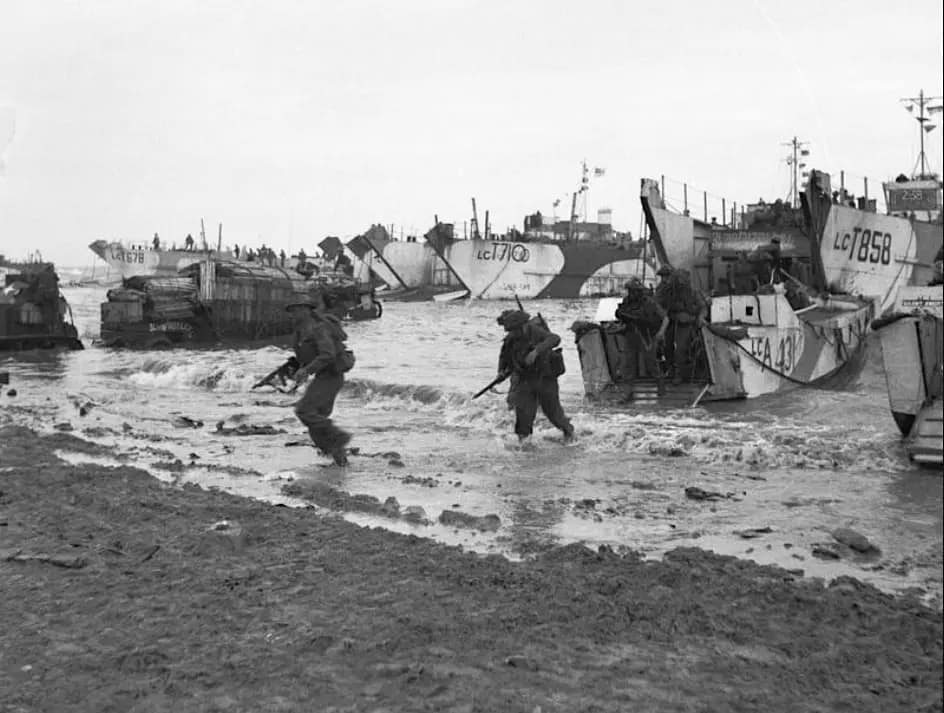
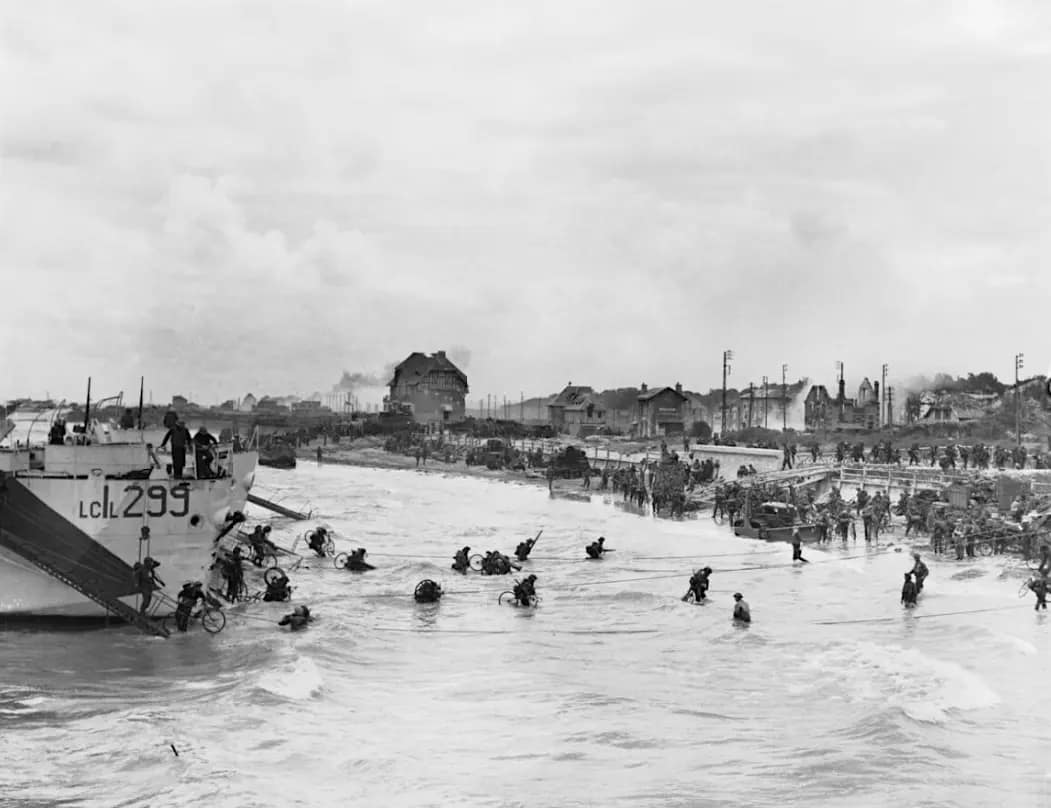
At Gold Beach, Juno Beach, and Sword Beach, British and Canadian forces also faced intense combat. Despite varying levels of resistance, Allied troops successfully established beachheads along the Normandy coastline by the end of the day.
The human cost of June 6, 1944
By the evening of June 6th, approximately 156,000 Allied soldiers had landed in Normandy, including 133,000 arriving by sea and another 23,000 airborne troops.
Across all sectors, Allied forces suffered roughly 10,300 casualties during the first day of the invasion, including thousands killed in action. Before the operation began, military planners had feared losses could reach as many as 25,000 men in a single day.
The five D-Day Beaches: Utah, Omaha, Gold, Juno, and Sword
Utah Beach and Omaha Beach: the american sector
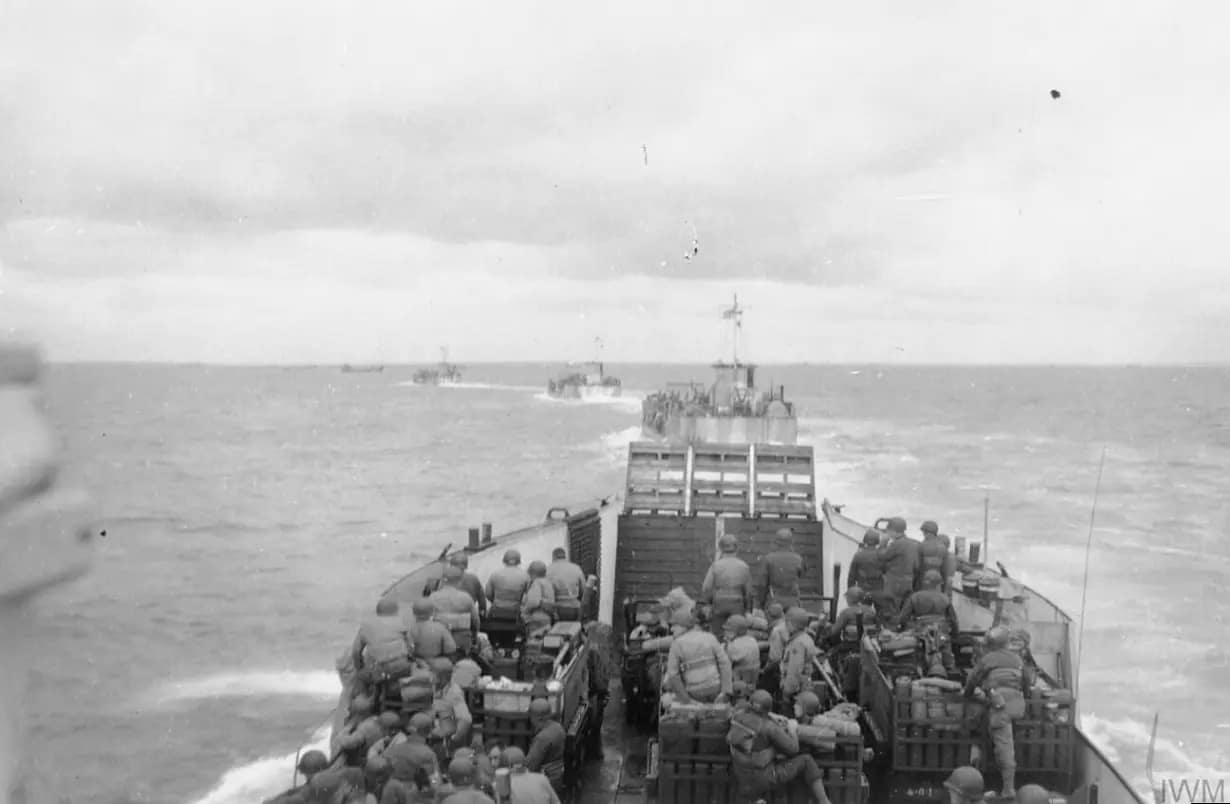
Located on the western edge of the invasion zone in the Cotentin Peninsula, Utah Beach became the first landing area successfully secured on June 6th. Strong ocean currents unexpectedly pushed the first American assault waves toward a less heavily defended section of coastline, significantly reducing casualties during the initial phase of the attack.
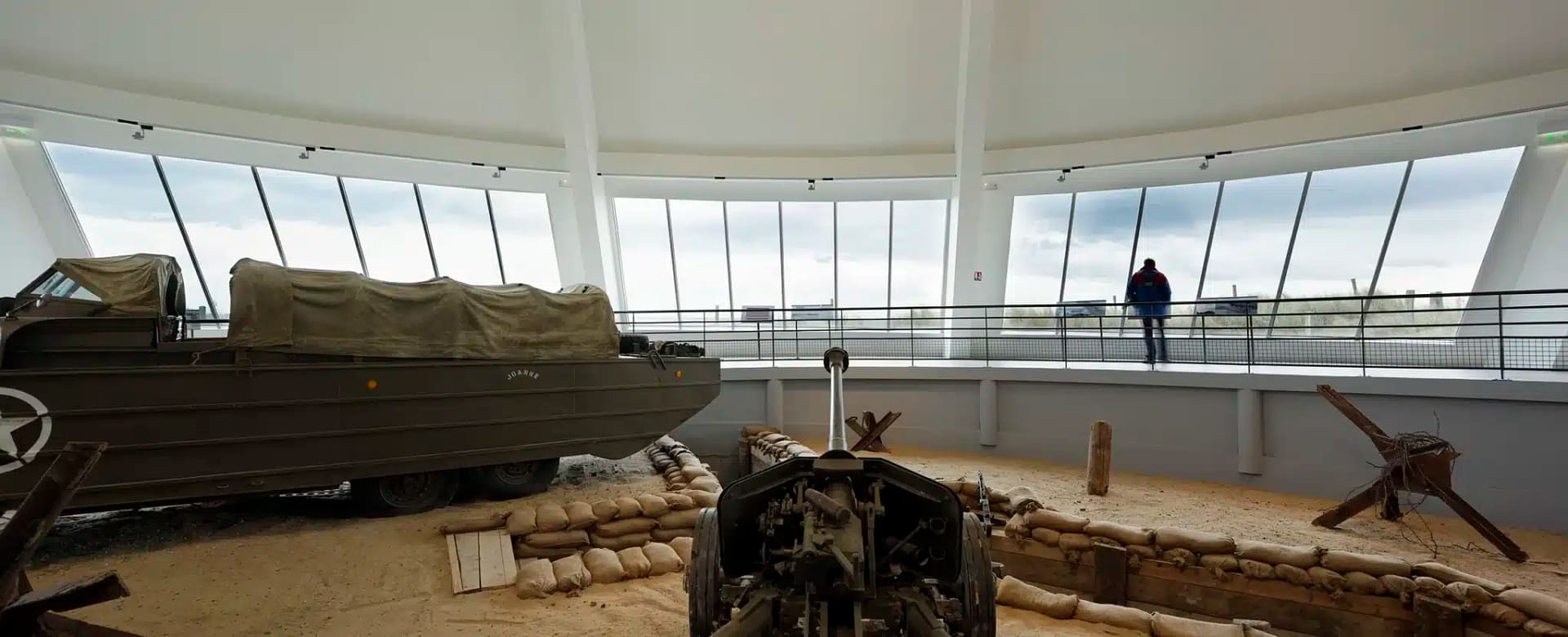
Today, the Utah Beach Landing Museum stands on the exact site where soldiers from the U.S. 4th Infantry Division came ashore during the D-Day Normandy WW2 invasion. Built in 1962 on the remains of the former German strongpoint WN5 at La Grande Dune, the museum now offers one of the most comprehensive memorial experiences connected to the Normandy landings of World War 2. Its exhibits cover more than 32,000 square feet. Inside, visitors can see authentic military vehicles, uniforms, weapons, and personal artifacts from the Second World War.
Omaha Beach presents a very different story. Nicknamed ‘Bloody Omaha’ by American troops, this stretch of coastline in Calvados witnessed some of the deadliest fighting of the entire Normandy campaign. The German 352nd Infantry Division, far stronger and more experienced than Allied intelligence had anticipated, inflicted devastating losses on the first assault waves. High cliffs overlooking the beach, combined with deeply entrenched defensive positions, turned Omaha into a deadly killing zone for several hours. Only through extraordinary sacrifice and determination were American soldiers able to break through the German defenses and advance inland.
Gold, Juno, and Sword: The British and Canadian Sectors
At Gold Beach, British forces successfully achieved their main objective by capturing the area around Arromanches-les-Bains before the end of the day. This location later became home to Mulberry B, one of the massive artificial harbors constructed by the Allies to supply troops after the June 6th invasion. The harbor played a vital logistical role during the weeks that followed the Normandy landings.
Juno Beach was assigned to Canadian forces, whose determination during the assault earned widespread recognition among the Allied armies. For many Canadian soldiers, the operation carried special significance after the failed Dieppe Raid of 1942. Despite heavy underwater obstacles that damaged many landing craft, Canadian troops advanced farther inland on D-Day than any other Allied force. Today, the Juno Beach Centre preserves the memory of Canada’s role in the Second World War through permanent exhibitions dedicated to the Normandy invasion.
Sword Beach, the easternmost of the five landing zones, was assaulted by British troops tasked with linking up with the airborne forces of the British 6th Airborne Division near Pegasus Bridge. That junction was successfully completed during the afternoon of June 6th, helping secure the eastern flank of the Allied beachhead in the opening stages of the campaign.
The Battle of Normandy: June to August 1944
Hedgerow fighting and the Allied breakthrough
After the success of the June 6th landings, Allied commanders hoped for a rapid advance across France. Instead, troops encountered one of the most difficult battlefields of the Second World War: the Normandy bocage.
This countryside of dense hedgerows, narrow sunken roads, and enclosed fields turned nearly every section of land into a natural defensive position. What followed became known as the ‘hedgerow battle,’ a slow and exhausting campaign fought field by field and village by village during the Battle of Normandy.
British forces spent weeks fighting to capture Caen, an objective originally expected to fall on the first day of the invasion. American troops, meanwhile, struggled through fierce resistance on the road toward Saint-Lô. The city was finally liberated on July 18 after intense combat and widespread destruction.
On July 25, 1944, General Omar Bradley launched Operation Cobra. This a massive aerial bombardment was designed to break through German defensive lines in western Normandy.
The breakthrough was decisive. Within days, American forces led by George S. Patton surged across France. The assault dramatically accelerated the collapse of German positions after the Normandy landings.
The liberation of Normandy and Paris
The final phase of the Normandy battle centered around the town of Falaise. German forces became trapped inside what is now known as the Falaise Pocket.
By August 19, the encirclement was nearly complete. Around 80,000 German soldiers were caught inside the pocket. Allied aircraft and artillery relentlessly attacked their escape routes and supply lines. On August 21, the pocket was officially sealed. The victory marked one of the most decisive defeats suffered by Germany in the Second World War.
Only a few days later, Paris was liberated on August 25, 1944.
The Battle of Normandy officially ended on August 30 with the liberation of the territories between the Loire and Seine rivers. The human cost of the campaign was enormous. Allied forces suffered approximately 37,000 killed and 172,000 wounded. German forces, however, lost more than 200,000 men through death, injury, or capture.
Normandy’s civilian population also paid a terrible price. Around 20,000 civilians lost their lives during the fighting. Many were killed in Allied bombing raids conducted before and after D-Day.
Order of battle: Allied troops and german forces
On June 6th, 1944, the Allied coalition launched the largest amphibious invasion of the Second World War. During D-Day, more than 156,000 Allied troops landed in Normandy. Nearly 6,939 ships and 11,600 aircraft supported the invasion through air cover, bombing missions, and airborne operations.
Over the course of the 87-day Normandy campaign, the scale of the Allied buildup became even more extraordinary. More than two million allied soldiers, 438,000 vehicles, and nearly three million tons of equipment were transported into Normandy following the June 6th landings.
On the German side, the Normandy coastline was defended by Army Group B under the command of Erwin Rommel. Although Hitler’s Atlantic Wall appeared formidable on paper, the strength of its defenses varied greatly depending on the sector.
The German divisions stationed along the coast on D-Day WW2 also differed significantly in training, equipment, and combat experience. German command structures suffered from major disagreements over how armored reserves should be deployed during the invasion. Rommel and Gerd von Rundstedt held conflicting views on the best defensive strategy. This contributed to confusion during the critical opening hours of the Normandy landings World War 2 campaign.
Military cemeteries and memorials in Normandy
The American Cemetery overlooking Omaha Beach
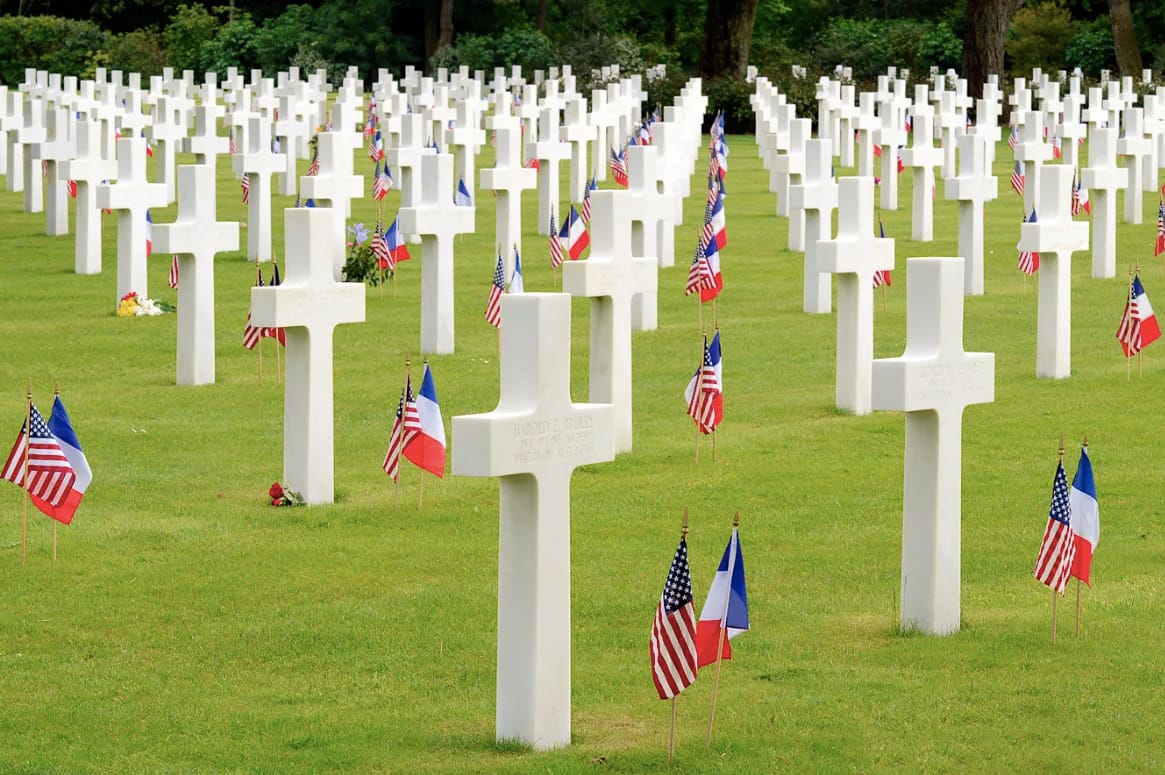
Overlooking Omaha Beach, the Normandy American Cemetery remains one of the most moving memorial sites connected to D-Day and the Second World War.
The cemetery contains 9,387 white marble headstones arranged in perfectly aligned rows above the English Channel. They commemorate American soldiers killed during the Normandy invasion and the Battle of Normandy.
Open year-round with free admission, the site also includes a visitor center. It features permanent exhibits, archival materials, and personal testimonies that help visitors understand the human cost of the Normandy campaign.
British and Canadian military cemeteries
Normandy is also home to numerous British and Canadian military cemeteries. All are maintained by the Commonwealth War Graves Commission.
Among the most visited sites are:
- Bayeux War Cemetery: the largest British military cemetery in Normandy, containing nearly 4,000 graves
- Bény-sur-Mer Canadian War Cemetery: honoring 2,048 Canadian soldiers killed during the Normandy landings
- Ranville War Cemetery: located in the first French village liberated on D-Day and home to the graves of British airborne troops from the 6th Airborne Division
Simple, carefully maintained, and deeply respectful, these cemeteries remain essential places of remembrance. They help visitors understand the scale of the sacrifice made during D-Day and the broader campaign in Normandy.
The Best D-Day museums to visit in Normandy
The Caen Memorial Museum
The Mémorial de Caen is often the first stop for visitors. It is designed to help them understand the broader context of the Second World War before exploring the D-Day beaches.
Built on the site of a former German bunker, the museum traces the history of the 20th century. Its exhibits cover the rise of Nazism through to the reconstruction of peace in Europe after the war.
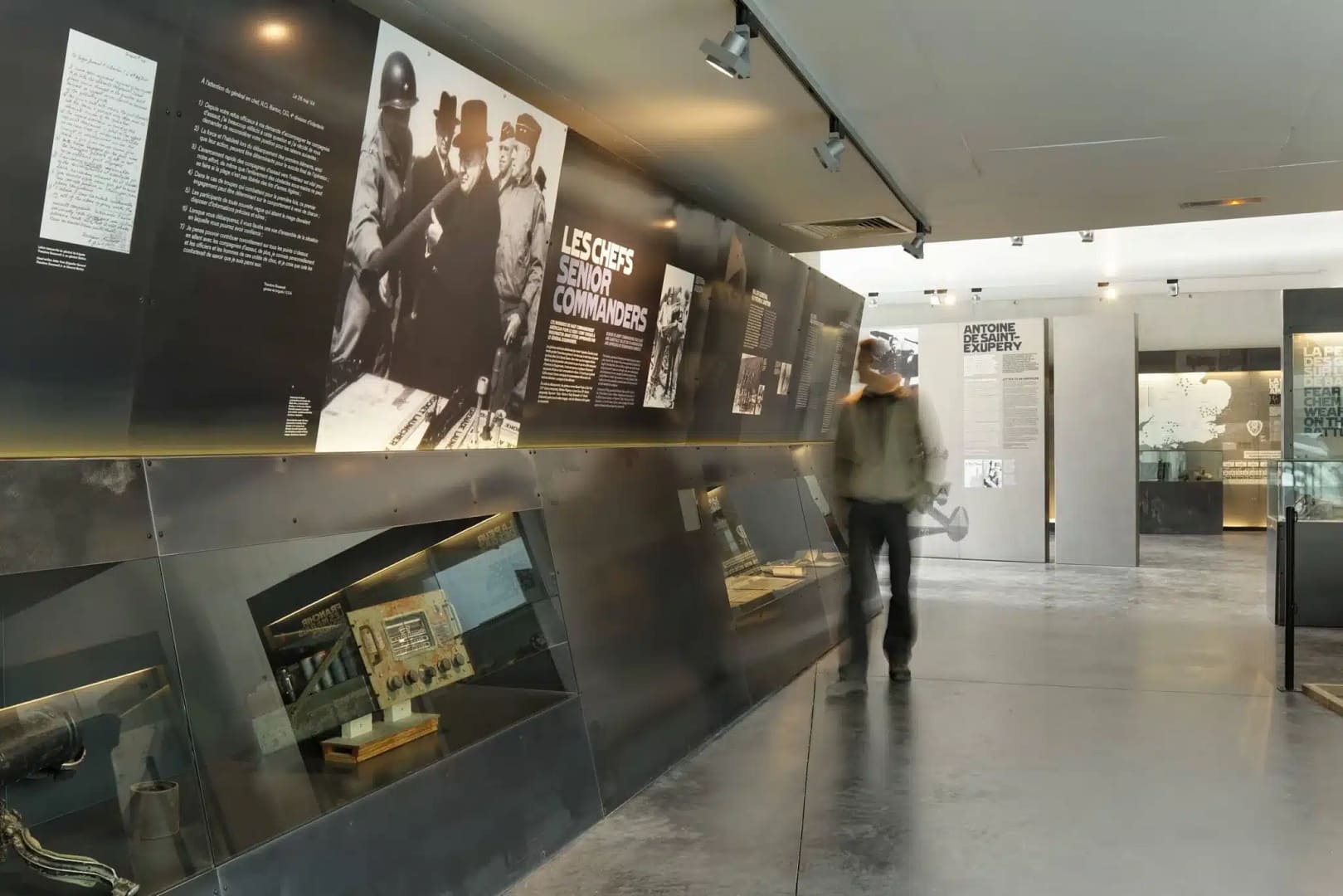
Its permanent exhibitions include archival footage, historical documents, immersive displays, and reconstructed wartime environments. The museum is especially popular with families and school groups looking for a deeper understanding of D-Day and the Battle of Normandy.
Museums along the D-Day Beaches
Several major World War 2 museums are located directly along the Normandy coast.
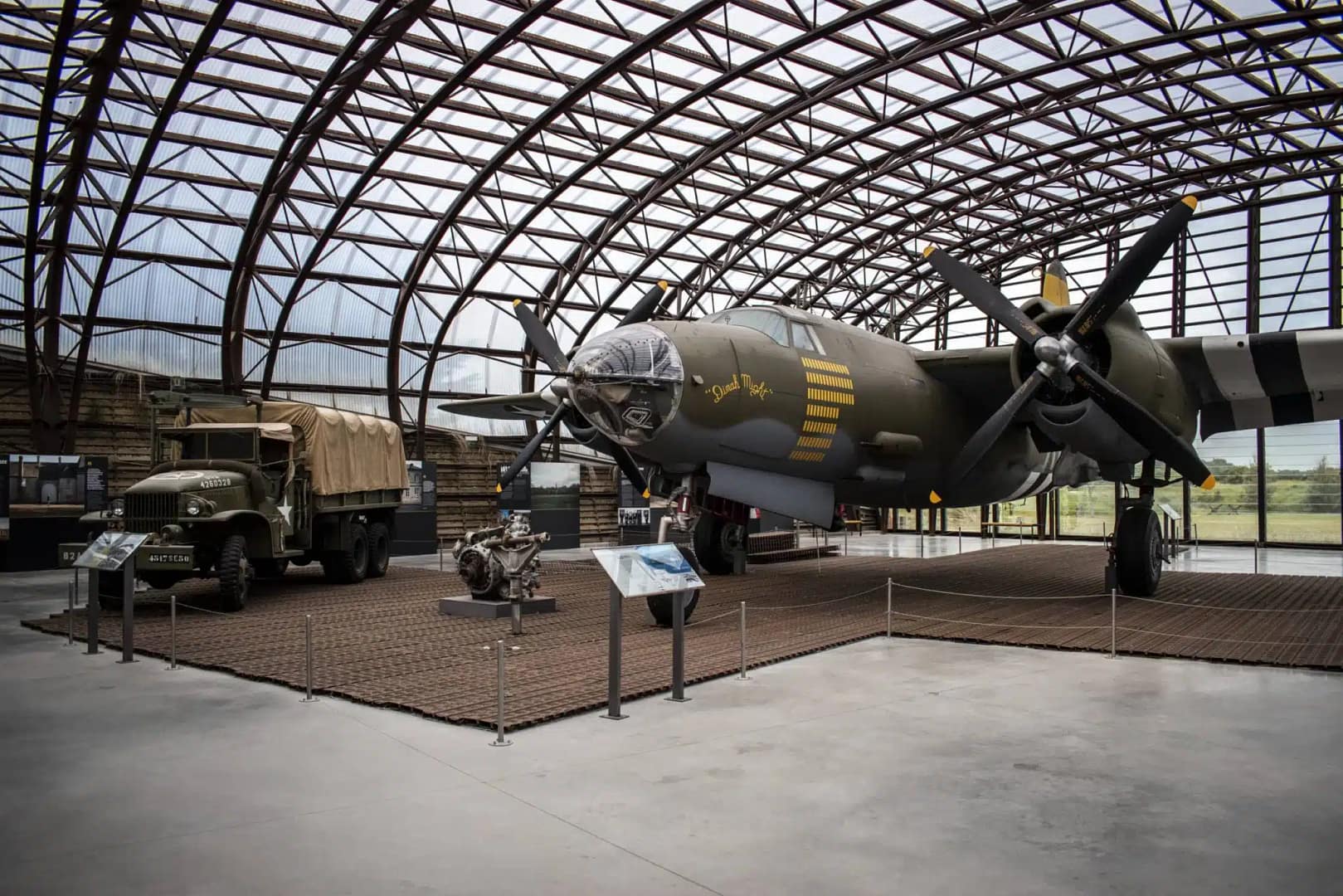
The Utah Beach Landing Museum stands directly on the beach where American troops landed on June 6th, 1944. The museum retraces the story of D-Day through ten chronological sections covering the preparation, execution, and aftermath of the Normandy landings World War 2 operation.
Its most famous artifact is an authentic B-26 Marauder bomber. Every year, the aircraft attracts thousands of aviation enthusiasts and military history visitors. With more than 200,000 visitors in 2024 and over 15,000 reviews across Tripadvisor and Google, the museum has become one of the leading memorial tourism sites connected to D-Day WW2.
The Overlord Museum near Omaha Beach features an exceptional collection of restored military vehicles, tanks, and wartime equipment displayed in a modern exhibition space.
The Airborne Museum focuses on the American paratroopers who landed before dawn on June 6th. The museum also tells the famous story of John Steele, whose parachute became caught on the church steeple in Sainte-Mère-Église during the airborne assault.
How to visit the D-Day Beaches: practical tips
A one-Day D-Day Beaches itinerary
Visitors with only one day in Normandy can still experience several of the most important D-Day WW2 sites.
A practical itinerary might include:
- Morning: departure from Caen or Bayeux, followed by visits to Omaha Beach and the Normandy American Cemetery
- Midday: lunch in Bayeux or Arromanches, then a visit to the Musée du Débarquement d’Arromanches and the remains of the Mulberry Harbor
- Afternoon: drive to Utah Beach to visit the Utah Beach Landing Museum, followed by a walk along the beach and nearby German bunkers
Visitors staying two days or longer should also consider adding the Mémorial de Caen, the Airborne Museum, and the Juno Beach Centre to their itinerary.
Visiting the D-Day sites with a specialized guide
Exploring the Normandy battlefields with a specialized guide can greatly enrich the experience.
Experienced guides often share battlefield stories, strategic details, and local anecdotes that many independent visitors would otherwise miss. They can also adapt the visit depending on the interests and historical knowledge of each group.
The Utah Beach Landing Museum offers guided tours. These are designed for visitors who want a deeper understanding of the June 6th landings and the broader history of D-Day in Normandy.
D-Day commemorations: ceremonies and events
Official June 6th ceremonies
Every year, the June 6th ceremonies bring together heads of state, diplomats, veterans’ families, and thousands of visitors from around the world. These commemorations honor the soldiers who fought during the D-Day Second World War operations and helped change the course of history.
The day usually begins with tributes in military cemeteries across Normandy. Wreath-laying ceremonies and moments of silence pay respect to the fallen. Official events then continue along the historic landing beaches of the Normandy landings World War 2 campaign.
Speeches throughout the day highlight the sacrifice made by Allied troops during D-Day WW2. They also remind visitors of the values defended on June 6th, 1944: freedom, democracy, and peace.
During the 80th anniversary in 2024, around 4,500 guests and several world leaders gathered at Omaha Beach for the main international ceremony. The event drew visitors from across the United States, Canada, Europe, and beyond.
The 2026 anniversary of the Normandy landings
On June 6th, 2026, Normandy will mark the 82nd anniversary of the landings. This year again, Utah Beach will stand at the heart of the commemorations.
It was here, on this stretch of the Cotentin coast, that soldiers from the U.S. 4th Infantry Division came ashore at dawn on June 6th, 1944. More than eight decades later, the memory of those events remains deeply present.
Official ceremonies, wreath tributes, and gatherings of veterans’ families from the United States, Canada, and the United Kingdom will take place throughout the day. For many visitors, Utah Beach remains one of the most emotional locations connected to D-Day Normandy WW2 history.
Beyond the beach itself, the entire Normandy region comes alive in the days leading up to the anniversary. Beginning in late May, towns and villages are decorated in period colors and wartime banners. Historical reenactments, military band performances, vintage vehicle convoys, and photography exhibits recreate the atmosphere of the 1940s.
For international visitors, attending these commemorations is far more than a sightseeing experience. It is a chance to connect personally with the history of the Normandy battle WW2 campaign and better understand what Allied troops endured on that morning of June 6th.
Many travelers also combine the ceremonies with visits to a nearby Utah Beach Landing Museum or other World War 2 museum sites across Normandy. These visits help deepen their understanding of the events that shaped the outcome of the war.
The D-Day Festival Normandy: a major commemorative gathering
Festival highlights and main events
First launched in 2007, the D-Day Festival Normandy will celebrate its 20th edition in 2026. The festival runs from May 30 through June 14, 2026, across the historic coastline of the D-Day Second World War landings and the Battle of Normandy.
Events take place throughout the region, from Pegasus Bridge to Sainte-Mère-Église. Major locations also include Ouistreham, Arromanches, Pointe du Hoc, and the five famous landing beaches connected to D-Day Normandy WW2 history.
Some of the most anticipated events include:
- La Berniairèse, a gathering of sailing and rowing boats near the Canadian House in Bernières-sur-Mer on June 6th, 2026
- The 26th edition of Camp Hillman in Colleville-Montgomery, running from June 4th to June 7th, 2026
- The Marathon de la Liberté, part of the 39th Courants de la Liberté events, crossing the Juno and Sword Beach sectors from June 4th to June 7th
- Station Radar 44, featuring a reenactment camp, British military vehicles, and wartime communications demonstrations on June 13th and 14th
Throughout the two-week festival, visitors can also attend military band concerts, historical conferences, parachute drops, vintage dances, and live performances for all ages.
Practical information: transportation, tickets, and lodging
Visitors traveling from Paris can reach Normandy via the A13 highway toward Caen, then continue on the N13 toward Carentan and the Cotentin Peninsula.
Most festival locations provide free parking nearby. For travelers using public transportation, the Carentan train station offers access to several important D-Day WW2 sites and commemorative events.
The towns of Sainte-Marie-du-Mont, Carentan-les-Marais, Sainte-Mère-Église, and Bayeux offer many lodging options close to the historic beaches and museums. Visitors will find hotels, guesthouses, vacation rentals, and campgrounds throughout the region.
Because of the popularity of the June 6th anniversary period, accommodations often sell out as early as March. Booking at least two months in advance is strongly recommended, especially for American travelers planning a World War 2 museum tour through Normandy.
Most commemorative ceremonies and public events are completely free and open to everyone. Visitors can easily combine the festival with stops at historic locations such as the Utah Beach Landing Museum and other major memorial sites connected to the Normandy battle WW2 campaign.
The logistics of D-Day: an unprecedented military achievement
Beyond the courage shown by Allied troops, the Normandy landings World War 2 operation was also one of the greatest logistical achievements in military history.
In just 87 days, more than two million Allied soldiers crossed the English Channel from Britain to France. With them came 438,000 vehicles and nearly three million tons of supplies and equipment.
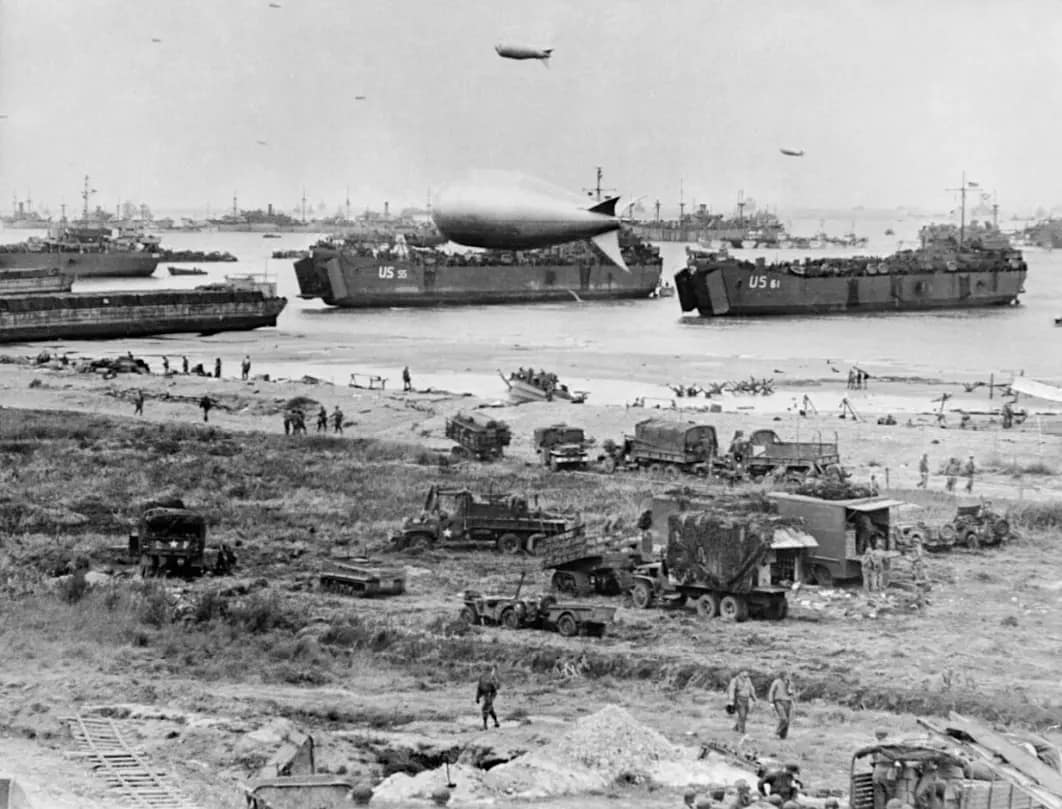
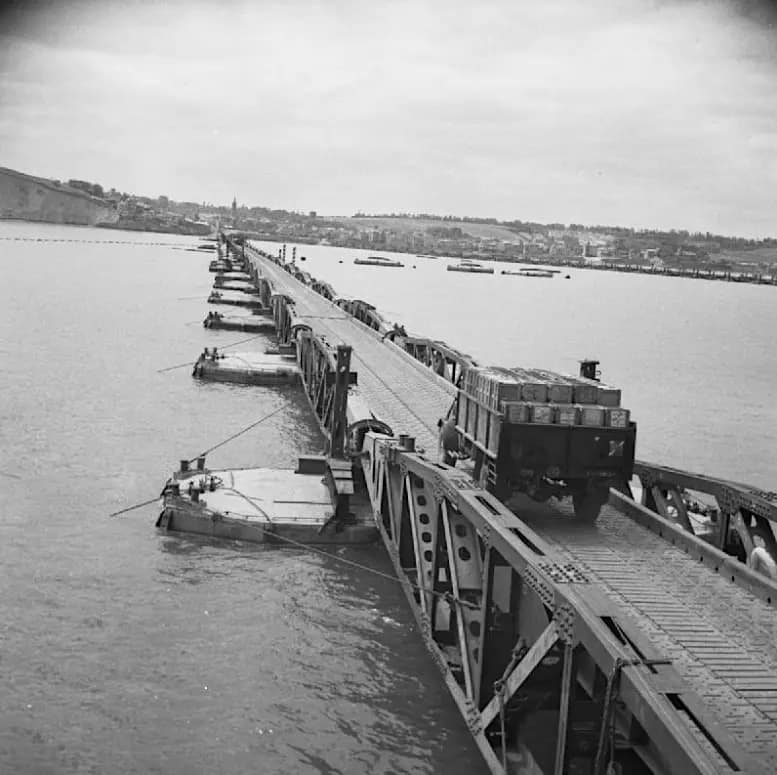
One major problem quickly became clear after June 6th. The Allies needed deep-water ports to unload troops, fuel, weapons, and vehicles, but no major port had been captured during the first days of the invasion.
To solve this issue, Allied engineers created two massive artificial harbors known as the Mulberries. Huge concrete sections were built in England, then towed across the Channel and assembled off the Normandy coast.
The American Mulberry Harbor near Omaha Beach was badly damaged by a violent storm on June 19, 1944. The British harbor at Arromanches, often called Port Winston, remained operational for eight months.
During that time, it handled roughly 20% of all men, vehicles, and equipment brought into Normandy through late August 1944. The harbor became one of the key supply hubs supporting the D-Day WW2 campaign and the broader advance into occupied Europe.
Fuel supply created another enormous challenge. To keep Allied forces moving after the landings, engineers developed an underwater pipeline system called PLUTO, short for “Pipe Line Under The Ocean.”
This pipeline transported fuel directly beneath the English Channel from England to mainland Europe. It allowed Allied armies to maintain momentum during the Normandy battle WW2 operations that followed the initial invasion.
The success of the D-Day campaign did not rely on battlefield victories alone. It also depended on months of careful planning. In many ways, Allied logistics proved just as decisive as combat itself.
The legacy of D-Day: a lasting historical impact
The D-Day landings permanently changed the course of modern history. By opening a major front in Western Europe, the Allied invasion accelerated the collapse of Nazi Germany and helped liberate Western Europe in less than a year. Yet the legacy of June 6th extends far beyond military strategy alone.
The values defended during D-Day WW2 still resonate today. Freedom, cooperation between democratic nations, and resistance against tyranny remain central themes in official ceremonies and public remembrance across the Western world.
Normandy itself was deeply transformed by the events of 1944. Today, its landing beaches, military cemeteries, memorials, museums, and rebuilt villages form one of the world’s most important remembrance landscapes linked to the Normandy campaign.
Efforts are currently underway to secure UNESCO World Heritage recognition for the D-Day landing beaches and their surrounding historical sites. The initiative is actively supported by the Normandy Region and many public and private partners.
The Utah Beach Landing Museum plays an important role in preserving this memory. Alongside regional organizations and historical institutions, the museum contributes to the “Liberté, j’inscris ton nom” initiative, dedicated to protecting and sharing the legacy of June 6th for future generations.
FAQ about D-Day in Normandy
What is the difference between D-Day and the Battle of Normandy?
D-Day refers specifically to June 6th, 1944, the day Allied forces landed on the five Normandy beaches during the invasion.
The Battle of Normandy covers the much longer military campaign that followed. It lasted from June 6th through August 30th, 1944, as Allied forces pushed across Normandy and liberated territory between the Loire and Seine rivers.
In other words, D-Day marked the beginning of the larger Normandy campaign.
How many soldiers landed on June 6th, 1944?
On June 6th, 1944, approximately 156,000 Allied troops reached Normandy. Around 133,000 arrived by sea, while another 23,000 airborne soldiers were deployed behind enemy lines.
The invasion force was supported by 6,939 ships and nearly 11,600 aircraft. These numbers make the Normandy landings the largest amphibious invasion in military history.
Can you visit the D-Day Beaches for free?
Yes. All major D-Day beaches in Normandy are freely accessible to the public.
The American Cemetery overlooking Omaha Beach is also open year-round at no cost. Many memorial sites and monuments across Normandy can be visited without an admission fee.
Most museums, however, require tickets. The Utah Beach Landing Museum currently offers adult admission at €10 and children’s admission (ages 6–15) at €6.50. Reduced rates are available for teachers, veterans, military personnel, job seekers, and large families.
Where exactly is Omaha Beach located?
Omaha Beach is located in the Calvados department of Normandy, in the town of Saint-Laurent-sur-Mer. It stretches between Vierville-sur-Mer to the west and Colleville-sur-Mer to the east.
The beach lies about 18 miles northwest of Bayeux and roughly 28 miles north of Saint-Lô. The American Cemetery overlooking the beach remains one of the most visited memorial sites in France and an important place of remembrance connected to the Normandy campaign.
Conclusion
More than eighty years later, D-Day remains far more than a military operation remembered in history books.
These beaches witnessed the sacrifice of thousands of young Allied soldiers who fought for freedom, dignity, and the defeat of tyranny. Walking along the Normandy shoreline today gives visitors a powerful sense of what was at stake on that morning of June 6th.
Rows of white crosses stretch across the cliffs above Omaha Beach. Veterans’ stories continue to echo through museums, memorials, and guided tours across the region. Together, these places preserve the memory of the men who fought during the D-Day campaign.
The Utah Beach Landing Museum helps visitors experience this history through immersive exhibits, a clear chronological journey, and guided tours designed for all audiences.
As the 82nd anniversary approaches, visitors from the United States and around the world are expected once again along the Normandy coast. Full event details for the 2026 commemorations are available on the museum’s official website, where tickets and guided visits can also be booked online.